

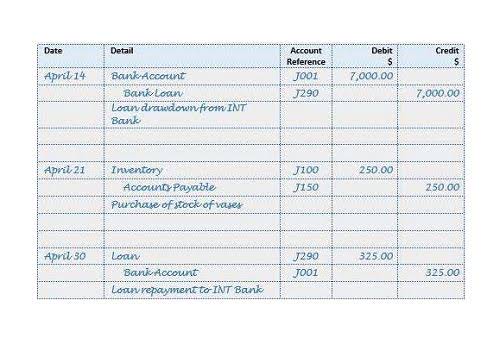
This transparency is essential for investors, creditors, and anyone else evaluating the company’s financial health. The purpose of journalizing is to record the change in the accounting equation caused by a business event. Ledger Payroll Taxes accounts categorize these changes or debits and credits into specific accounts, so management can have useful information for budgeting and performance purposes. Since so many transactions are posted at once, it can be difficult post them all. In order to keep track of transactions, I like to number each journal entry as its debit and credit is added to the T-accounts.
- Mocha Accounting is a valuable tool for asset accounting, especially from the management perspective.
- A Discount on Notes Payable, for instance, accounts for the difference between the cash received and the note’s face value.
- However in a manual accounting system, the accountant develops a custom numbering system for the company.
- Unlike a normal asset account, a credit to a contra-asset account increases its value while a debit decreases its value.
- To decrease a Liability, such as paying off a loan principal, a Debit entry is required.
T-account examples
Noncurrent liabilitiesThese are also referred to as long-term liabilities. In other words, these obligations will not be due within one year of the balance sheet date. Examples include portions of automobile loans, portions of mortgage loans, bonds payable, and deferred income taxes. Some accounting software will allow you to indicate the adjusting entries you would like to have reversed automatically in the next accounting period. If $3,000 has been earned, the Service Revenues account must include $3,000.
T-Account Debits and Credits
The chart of accounts consists of balance sheet accounts (assets, liabilities, stockholders’ equity) and income statement accounts (revenues, expenses, gains, losses). The chart of accounts can be expanded and tailored to reflect the operations of the company. Contra asset accounts are essential for providing a realistic valuation of a company’s t accounts assets. They are primarily used to account for the depreciation, depletion, or obsolescence of the company’s assets, which helps to present a more accurate financial position. For instance, Accumulated Depreciation is a contra asset account that shows the cumulative depreciation of physical assets like machinery and equipment.
- A decrease in the value of a long term asset to an amount that is less than the amount shown under the cost principle.
- For different accounts, debits and credits can mean either an increase or a decrease, but in a T Account, the debit is always on the left side and credit on the right side, by convention.
- All transactions related to this checking account will be recorded in a ledger account called Cash in Bank.
- Since the net income was computed using the accrual method of accounting, it needs to be adjusted in order to reflect the cash received and paid.
- A listing of the accounts available in the accounting system in which to record entries.
Accounting Software To Manage and Track Assets
They’re especially useful when creating journal entries, as they give a clear visual of how each transaction affects your business’s finances. At the top of the spreadsheet, the total debits and credits for all the accounts are shown. Students can use T accounts to learn about accounting and how transactions affect different accounts on the general ledger using the double entry system.

- For example, we can compare companies operating across different industries and compare how much $ of revenue a tech company generates for every $ of capital invested vs. a manufacturing company.
- Paid-in CapitalPaid-in capital is a subheading within stockholders’ equity which indicates the amount paid to the corporation at the time that shares of stock were issued.
- Conversely, an account has a Credit Balance when the total credits are higher than the total debits.
- The numbers in your company’s financial statements show the overall picture but reveal only a glimpse of the full story.
- For liabilities and equity accounts, however, debits always signify a decrease to the account, while credits always signify an increase to the account.
T-accounts, in contrast, are visual tools used to analyze how transactions impact individual accounts. Shaped like a “T,” they separate debits (left side) and credits (right side) to show how each entry alters a specific account’s balance. This entry accurately records the utility expense and the cash outflow, maintaining the balance in the t-account accounting equation. This double-entry balances the T-accounting equation, with total debits equal to total credits.


The debit entries recorded on the left side of a T-account must be equal to the credit entries on the right side. If they don’t balance, it’s important to double-check your books, as this usually indicates an accounting error that needs correction. The matching principle in accrual accounting states that all expenses must match with revenues generated during the period. T-accounts can also be used to record changes to a company income statement, where revenues (profits) and expenses (losses) are recorded.

How are contra assets accounts presented?
To determine whether errors had occurred, the bookkeeper prepared a trial balance. A trial balance is an internal report that lists 1) each account name, and 2) each account’s balance in the appropriate debit column or credit column. If the total of the debit column did not equal the total of the credit column, there was at least one error occurring somewhere between the journal entry and the trial balance. Finding the one or more errors often meant spending hours retracing the entries and postings.
The Critical Role of Contra Accounts in Accurately Depicting Financial Position
A T-account is a visual representation of a financial account for a financial accounting period. Although the list format ultimately works, T-accounts and similar reports are much easier to read and use. T-accounts bookkeeping are also helpful in the accounting cycle before preparing trial balances. However, you should also make necessary precautions before deleting an account to avoid any irreversible mistakes. It is recommended to keep any unused accounts for at least until the end of a 12-month accounting period before deleting them.